
How to Select the Right Gear Ratio for Your Application
Learn what gear ratio is, how it affects speed and torque, and why it is crucial for efficient power transmission in mechanical systems.

Selecting the right gear ratio is one of the most important decisions when selecting a motion control system for an application. Whether it is industrial automation, robotics, solar cleaning systems, or packing systems, the gear ratio directly affects the performance, efficiency, and life span of the application.
Many engineers either simplify the process or rely on trial-and-error to select the right gear ratio, resulting in underperformance in the application.
In this blog, we will break down how to select the right gear ratio step by step to ensure efficient application performance.
What is Gear Ratio??
A gear ratio is a fundamental principle in all mechanical systems, determining the connection between the input speed, which is the motor's speed, and the output speed, which is the driven load's speed. It indicates the number of rotations the input shaft must make to achieve a single rotation of the output shaft.
Gear ratio affects the following parameters of a mechanical system: speed and torque. If the gear ratio increases, the output speed of the shaft decreases and the torque increases. On the other hand, if the gear ratio decreases, the output speed increases, and the torque decreases.
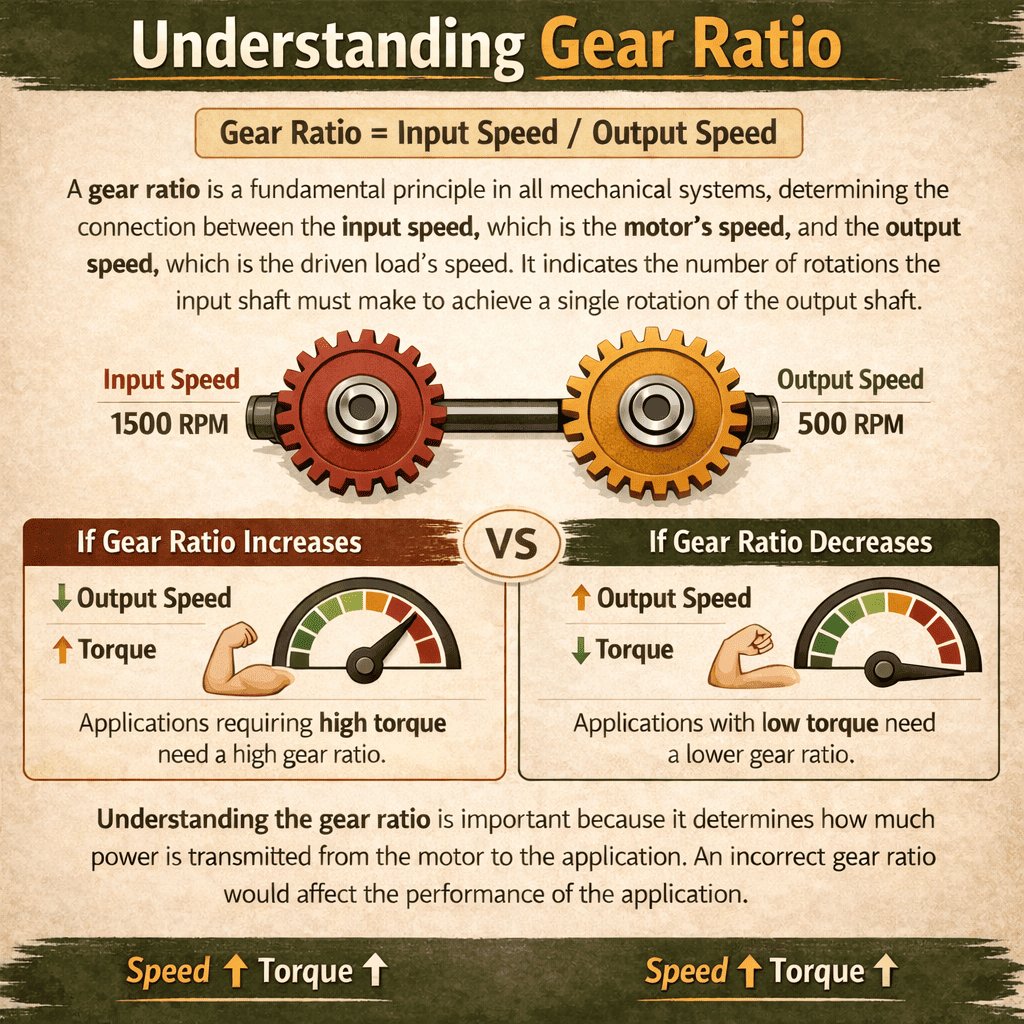
This comparison is important while selecting a motor for an application. Applications that require high torque for functioning require a high gear ratio, while applications with low torque require a lower gear ratio.
The gear ratio for the mechanical system can be achieved through different types of gears, such as spur gears, planetary gears, and worm gears.
Understanding the gear ratio is important because it determines how much power is transmitted from the motor to the application. An incorrect gear ratio would affect the performance of the application.
How to Calculate Gear Ratio??
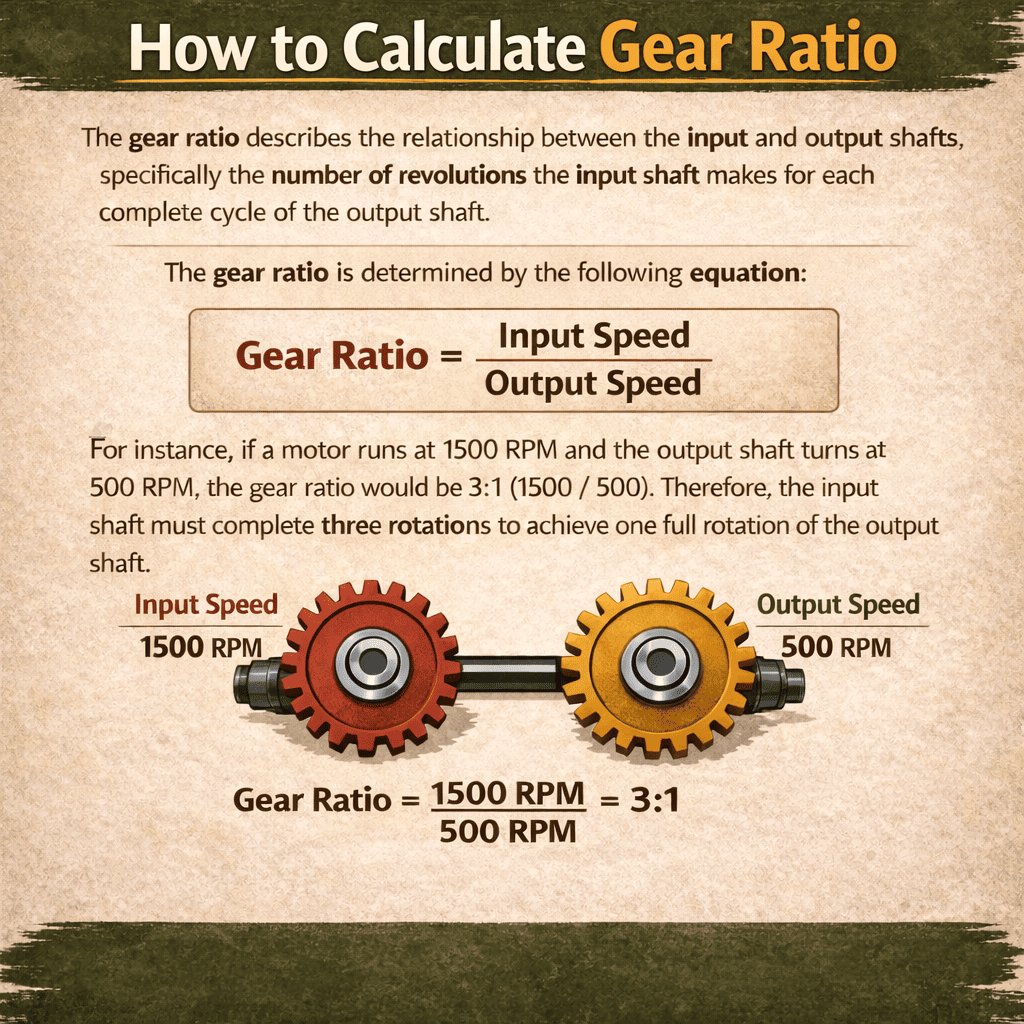
The gear ratio describes the relationship between the input and output shafts, specifically the number of revolutions the input shaft makes for each complete cycle of the output shaft.
The gear ratio is determined by the following equation:
Gear Ratio = Input Speed / Output Speed
For instance, if a motor runs at 1500 RPM and the output shaft turns at 500 RPM, the gear ratio would be 3:1 (1500/500). Therefore, the input shaft must complete three rotations to achieve one full rotation of the output shaft.
Alternatively, the gear ratio can also be calculated using this formula:
Gear Ratio = Number of Teeth on Driven Gear / Number of Teeth on Driving Gear
For example, if the driven gear has 1000 teeth and the driving gear has 100 teeth, the gear ratio is 10:1 (1000/100). This means the input shaft must rotate ten times to complete one rotation of the output shaft.
It's crucial to consider various factors, such as efficiency losses and load conditions, when calculating the gear ratio for a specific application.
One must consider torque when calculating the gear ratio to ensure that the selected gear ratio meets the speed and torque requirements.
Importance of Gear Ratio
The gear ratio is a crucial concept that defines how well an application works, how efficiently it uses energy, and how reliable it is. It's more than just a number; it affects how power is transmitted and used in a given application.
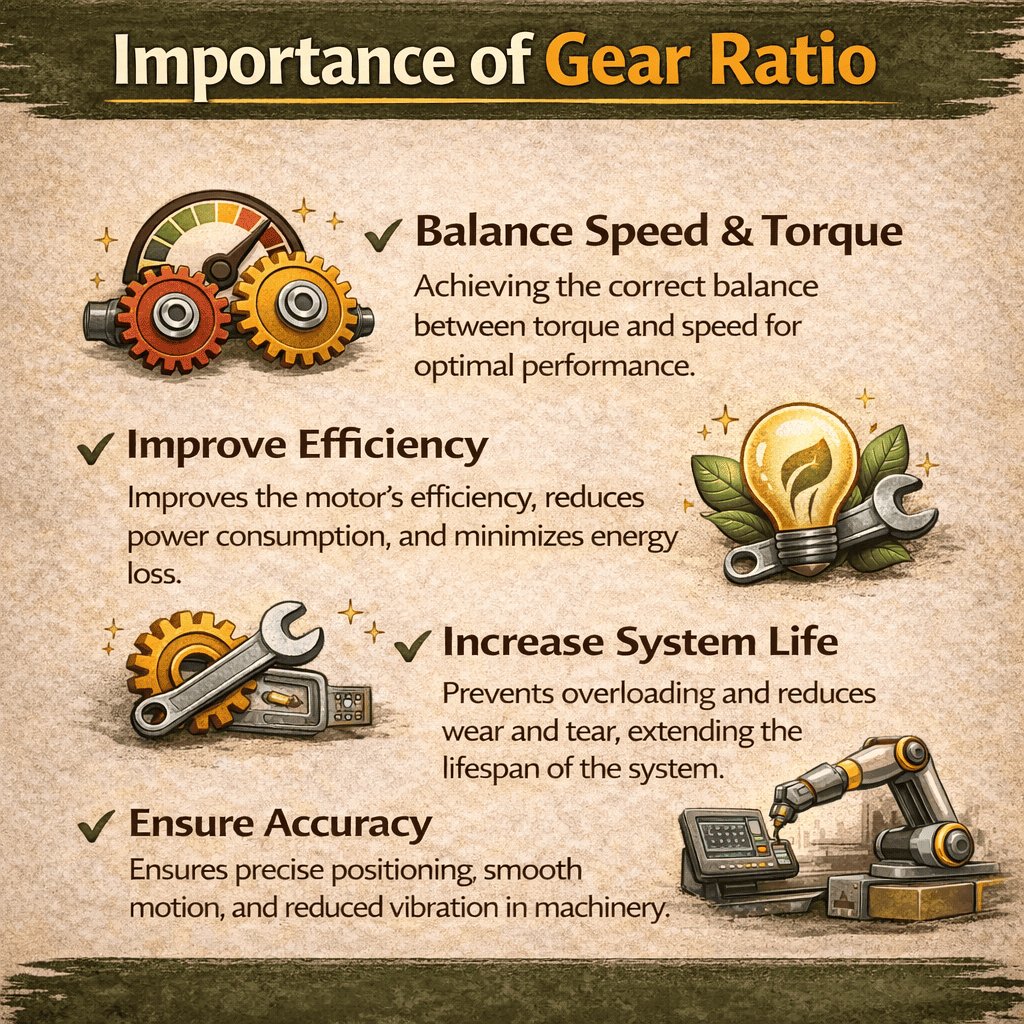
The following points explain why the gear ratio is important in an application:
- Torque and Speed Balance
Many applications require a careful balance between speed and torque.
Lifting, conveying, and robotic applications require high torque but with low speed, while cooling fans require high speed with low torque. The gear ratio enables this perfect balance for efficient performance.
- Energy Efficiency
An optimal gear ratio ensures the motor operates at full efficiency for optimal performance. If the gear ratio is very high or low, the motor might consume more power and lead to energy losses.
- System durability and lifespan
Incorrect gear ratio selection can lead to overloading and excessive heat, resulting in premature wear and frequent maintenance issues.
- Accuracy and control
In applications such as robotics, CNC machines, and medical devices, an optimal gear ratio ensures smooth movement, reduced vibration, and precise positioning.
One must consider the torque while calculating the gear ratio to ensure that select gear ratio meets the speed and torque requirements.
How to Select a Gear Ratio for an Application??
To select the right gear ratio for an application, we require a comprehensive process that involves both technical parameters and practical conditions.
The initial step in selecting a gear ratio is to understand the application's requirements. Determined the output speed, torque, and type of load for an application. This laid the foundation for selecting the right gear ratio.
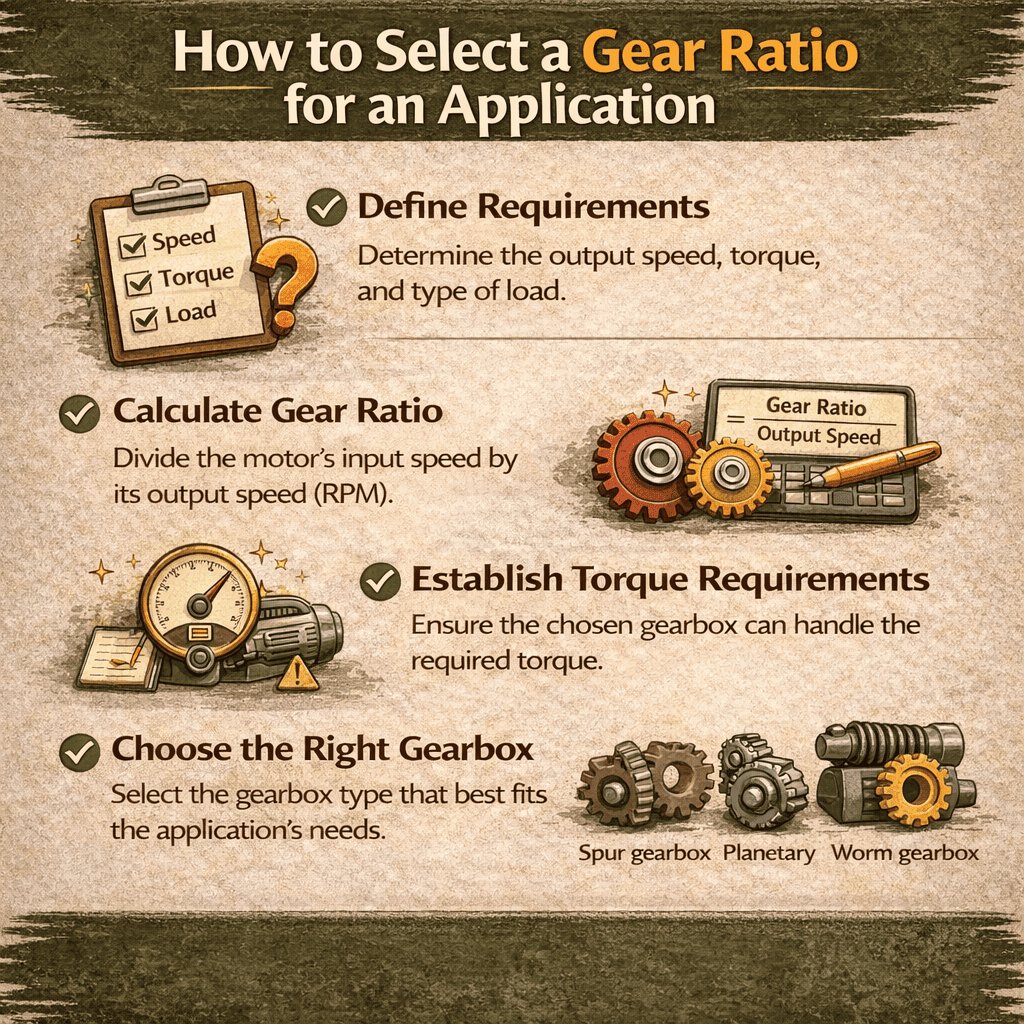
The next step is to calculate the gear ratio. The gear ratio is determined by dividing the motor's input speed by its output speed, expressed in revolutions per minute (RPM).
Gear Ratio = Input Speed (RPM) / Output Speed (RPM)
Once the gear ratio is calculated, the motor's torque requirements must be established. This step is crucial to ensure the gearbox's capacity to manage the motor's torque, thereby facilitating efficient motion. This precautionary measure prevents application overload and contributes to a prolonged operational lifespan.
The next step is the selection of an appropriate gearbox for the motor, which follows:
- Spur gearboxes are characterised by their simplicity and cost-effectiveness.
- Planetary gearboxes are distinguished by their ability to deliver high torque.
- Worm gearboxes provide substantial reduction ratios, coupled with a self-locking mechanism.
Furthermore, the motor's compatibility must be assessed, encompassing factors such as shaft dimensions, mounting configurations, and output speed specifications.
The final step is to validate all calculations with testing. Monitor performance, temperature, and noise under real operating conditions.
Applications Where Gear Ratio is Important
In many industrial settings, gear ratios are crucial, especially when controlling motion, torque, and speed is important.
Several applications exemplify this:
In industrial automation, Gear ratios find application in conveyor systems, assembly lines, and packaging machinery. These systems necessitate controlled velocities and consistent torque to facilitate smooth and efficient functionality. The appropriate selection of a gear ratio aids in maintaining synchronization and minimising operational interruptions.
Solar cleaning systems and robotic applications also rely heavily on gear ratios.
These systems, while functioning at reduced velocities, necessitate substantial torque to traverse panels and surmount frictional forces. A high gear ratio is essential for dependable and energy-conserving operation.
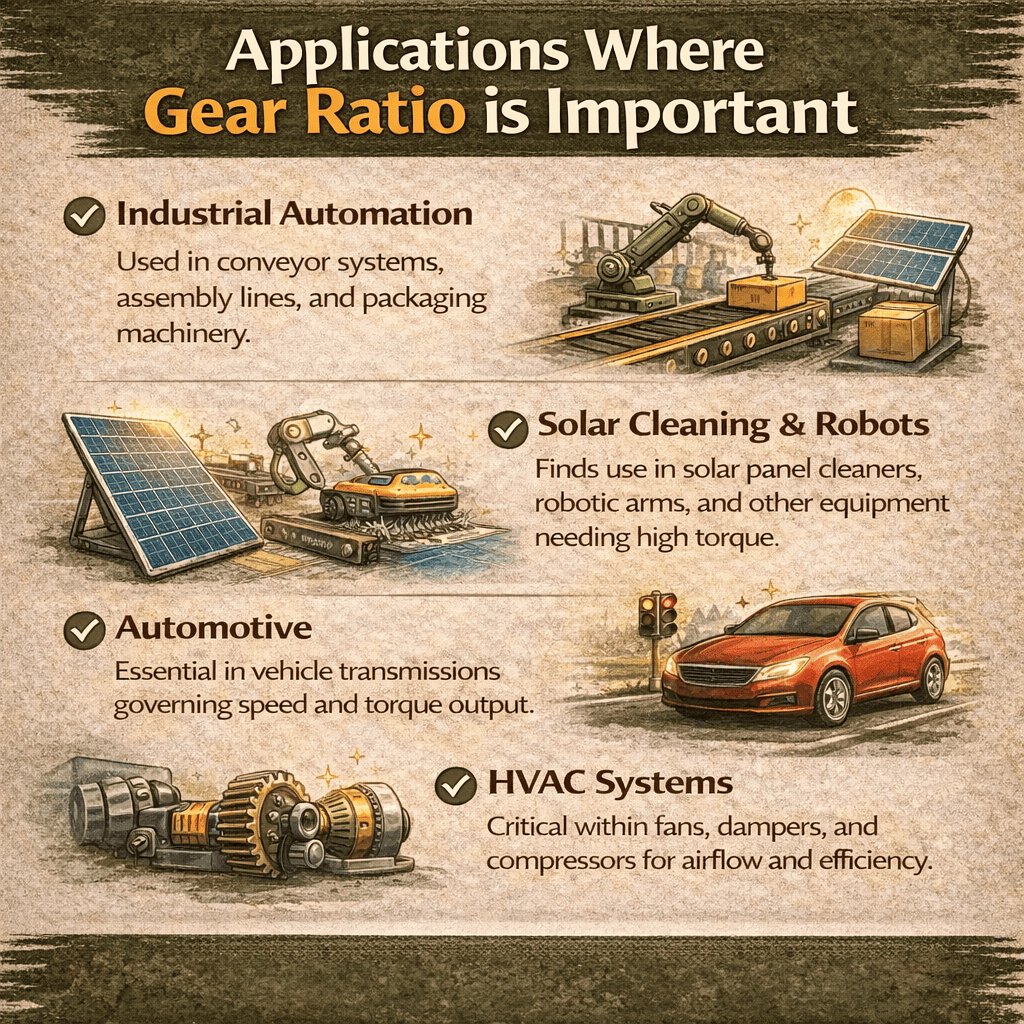
In the automotive sector, gear ratios are integral to transmissions, governing both vehicle speed and torque output. The application of diverse gear ratios enables vehicles to function optimally across a spectrum of operational scenarios, including acceleration, sustained travel, and ascent.
HVAC systems employ gear ratios within fans, dampers, and compressors to modulate airflow and uphold operational efficiency. The selection of an appropriate ratio is critical for achieving peak performance while minimising energy expenditure.